How Disability Insurance Income Protection Works: Replacing Lost Earnings After Disability

Introduction: The Hidden Risk of Income Loss in the United States
For most working Americans, income is their single most important financial asset. Unlike investments or property, income depends entirely on an individual’s ability to work. Yet many professionals underestimate the financial risk posed by illness or injury that interrupts employment.
Disability Insurance exists to address this risk directly. Rather than covering medical bills, disability insurance focuses on replacing a portion of lost income when a health condition prevents an individual from working. Understanding how disability insurance income protection works is essential for evaluating whether a policy provides meaningful financial security or only limited relief.
This article explains the income protection mechanism of disability insurance in the United States, including how benefits are calculated, when payments begin, and how policies coordinate with other income sources.
What Is Income Protection in Disability Insurance?
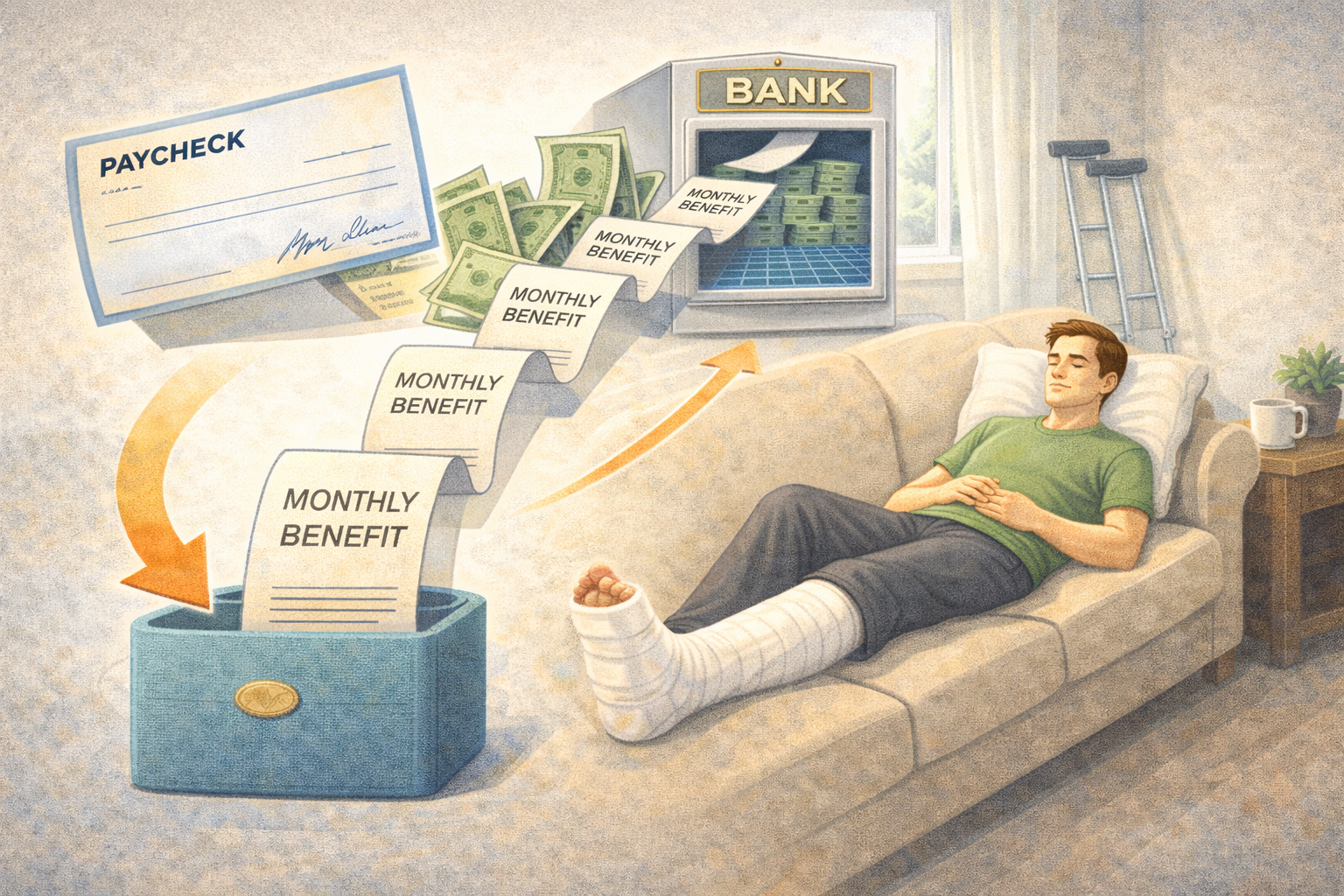
Income protection refers to the structured replacement of earned income when a person becomes disabled and cannot perform their occupational duties. Disability Insurance is designed to ensure continuity of cash flow so individuals can meet ongoing financial obligations such as housing, utilities, debt payments, and daily living expenses.
Unlike emergency savings—which may only last a few months—disability insurance provides ongoing income replacement for the duration of a qualifying disability, subject to policy terms.
In the U.S. insurance market, income protection is typically delivered through monthly benefit payments that continue as long as the insured remains disabled under the policy’s definition.
How Does Disability Insurance Income Protection Work?
To fully understand how disability insurance income protection works, it is important to examine the process from disability onset to benefit payment.
Step 1: A Qualifying Disability Occurs
Income protection begins when a covered illness or injury prevents the insured from working. The condition must be medically documented and meet the policy’s definition of disability. This may include:
-
Inability to perform occupational duties
-
Reduced functional capacity
-
Significant income loss due to health limitations
Step 2: The Elimination (Waiting) Period
Disability insurance policies include an elimination period, which is the time between the onset of disability and the start of benefit payments. Common elimination periods in the U.S. include:
-
30 days
-
60 days
-
90 days
-
180 days
During this period, the insured relies on savings, sick leave, or other short-term resources.
Step 3: Monthly Benefit Payments Begin
Once the elimination period is satisfied, the policy begins paying monthly benefits. These payments are designed to replace a percentage of the insured’s pre-disability income.
Income Replacement Ratios Explained
Most disability insurance policies in the United States replace 50% to 70% of gross income. This range is intentional and serves several purposes:
-
It provides sufficient income for essential expenses
-
It reduces incentives to remain disabled unnecessarily
-
It accounts for potential tax advantages
For example, an individual earning $6,000 per month before disability may receive between $3,000 and $4,200 in monthly benefits, depending on the policy.
Gross Income vs Net Income Replacement
An important distinction in disability insurance income protection is whether benefits are calculated based on gross or net income.
Employer-Provided Disability Insurance
Employer-sponsored disability insurance benefits are often taxable if the employer pays the premiums. As a result, after-tax income replacement may be lower than expected.
Individual Disability Insurance
Benefits from individually purchased disability insurance policies are typically tax-free if premiums are paid with after-tax dollars. This allows lower replacement percentages to provide comparable take-home income.
How Monthly Disability Benefits Are Calculated
Monthly benefit amounts are determined using several factors:
-
Pre-disability earnings
-
Maximum benefit caps
-
Policy income replacement percentage
-
Occupational classification
High-income earners may encounter benefit caps that limit the percentage of income replaced, making supplemental coverage necessary.
Partial and Residual Income Protection
Not all disabilities result in total inability to work. Disability insurance income protection often includes partial or residual benefits for individuals who experience reduced earnings due to medical limitations.
Partial Disability Benefits
Partial disability benefits apply when the insured can still work in a limited capacity but cannot perform all job duties.
Residual Disability Benefits
Residual benefits compensate for actual income loss, often calculated as a percentage of lost earnings compared to pre-disability income.
These features are especially valuable for professionals transitioning back to work gradually.
Cost-of-Living Adjustments and Inflation Protection
Long-term disabilities can last years or even decades. To maintain purchasing power, some disability insurance policies include cost-of-living adjustment (COLA) riders.
COLA riders increase benefit payments annually based on inflation indexes, helping preserve income protection over time.
Coordination with Other Income Sources
Disability insurance income protection does not always operate in isolation. Benefits may be coordinated with:
-
Employer sick leave
-
Workers’ compensation
-
Social Security Disability Insurance (SSDI)
-
Other disability policies
Some policies offset benefits from other sources, while others pay independently. Understanding these interactions is essential for accurate income planning.
Social Security Disability Insurance vs Private Income Protection
SSDI provides income support for individuals with severe, long-term disabilities. However, SSDI:
-
Has strict eligibility criteria
-
Requires long approval periods
-
Provides relatively modest benefits
Private disability insurance offers more flexible, timely, and predictable income protection, making it a critical supplement or alternative for many workers.
Why Income Protection Is the Core Value of Disability Insurance
At its core, Disability Insurance is not about medical care—it is about preserving financial independence. Income protection ensures that illness or injury does not immediately lead to financial instability, debt accumulation, or loss of long-term goals.
Understanding how disability insurance income protection works allows individuals to evaluate policy features intelligently, compare coverage options, and align protection levels with their financial responsibilities.
Key Takeaways for U.S. Workers and Professionals
Disability Insurance income protection works by replacing a portion of earned income when a medical condition prevents work. Through structured monthly benefits, elimination periods, and carefully designed replacement ratios, disability insurance provides stability during uncertain times.
For professionals, business owners, and self-employed individuals, income protection is not optional—it is foundational. Without it, even a temporary disability can create long-term financial consequences.
As the modern workforce becomes increasingly specialized and income-dependent, disability insurance remains one of the most effective tools for safeguarding financial resilience in the United States.

What is Disability Insurance?
Disability insurance is a vital policy designed to protect your income if you’re unable to work due to an illness or injury. It’s crucial for ensuring that you can continue to meet your financial obligations while focusing on your recovery. Without this income protection, unexpected health issues could lead to significant financial stress.
Types of Coverage Available
There are two primary types of disability insurance: short-term and long-term coverage. Short-term disability insurance typically provides benefits for a limited period, usually up to six months. In contrast, long-term disability insurance can extend for several years or even until retirement age. Understanding the differences in coverage can help you choose the best option for your situation.
Why You Need Disability Insurance
Many people underestimate the importance of disability insurance. Statistically, there’s a significant chance that an individual may become disabled at some point during their working life. With proper income protection, you won’t have to worry about losing your lifestyle or falling behind on bills. Investing in a comprehensive disability insurance policy today can provide you and your loved ones peace of mind for the future.
Latest Posts
- Is Disability Insurance Worth It in the United States? A Cost vs Risk Analysis

- Employer-Provided vs Individual Disability Insurance Coverage: What Works Best in the United States?
- Disability Insurance Eligibility Requirements in the United States: Who Qualifies and Why

- How Much Disability Insurance Coverage Do You Need in the U.S.? A Practical DFrameworkecision

- Disability Insurance Benefit Periods and Coverage Limits: How Long and How Much You’re Protected

Leave a Reply